|
Home > Articles > THE SHROUD OF TURIN
THE SHROUD OF TURIN
INTRODUCTION
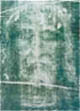 The Shroud, gradually, from an object of pious devotion to a number of Catholic, after it was photographed and made known in 1898 became an object of study and, necessarily, of controversy to hundreds of scientists, historians, theologians and scriptural experts. The Shroud, gradually, from an object of pious devotion to a number of Catholic, after it was photographed and made known in 1898 became an object of study and, necessarily, of controversy to hundreds of scientists, historians, theologians and scriptural experts.
Once widely believed and venerated as the actual burial cloth of Jesus, it was studied according to a variety of scientific disciplines, which virtually established its authenticity. Then it was subjected to radio-carbon dating. The results suggested that it was about 600 years old.
But let us begin at the beginning. In 1902, the photographs taken by a lawyer and amateur photographer, Mr. Secondo Pia, of Turin, fell into the hands of Yves Delage, professor of Comparative Anatomy at the Sorbone, member of the prestigious and very exclusive Academie Francaise, convinced and outspoken agnostic. After examining the photographs with care, he came to the conclusion that the marks of the wounds reproduced there were anatomically exact to a degree that excluded all falsification. He went one step further and concluded that the figure seen on that cloth, (the cloth itself being a rare specimen of a long forgotten way of weaving) could with all probability be the figure of Jesus of the Gospel Story. For an agnostic, that was quite a conclusion.
The shroud itself is a piece of linen cloth about 14 feet long, bearing head-to-head along its length the anterior and posterior images of a man. The image suggests that a man's body was laid upon one end, and the other end folded over the head to cover the front. 
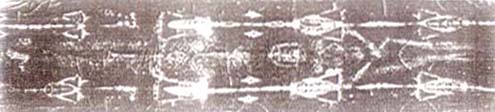
THE STATURE OF THE MAN
The image on the Shroud is of a male bearded adult, height 1.78 - 1.80. the evidence is that the cloth was laid on a flat surface under the body, it was then turned over the head and made to cover the front part of the body giving thus the whole picture of the body back and front head to head. The age of the man is 30-35 years, weighing 78 kgs approximately. He is a well built man of the muscular type a man who must have known hard physical work.
Carlton Cooc (ex Harvard professor) says: "Whoever the man of the Shroud could be, he is of the type still to be found in our days among the Sephardite Jews and Arabs of noble lineage. Rabbis and orthodox Jews, find the hair and beard of the man perfectly in keeping with the Jewish type of the first Century.
KIND OF DEATH
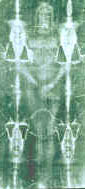 The many marks left of the sheet testify to a violent death: there are wounds, abrasions, piercing; the abdomen is swollen. A remarkable fact is evident: all the wounds are those described in the Gospel account of the passion of Christ. What counts most is that the wounds are anatomically correct, like the halo around each wound and blood stains testifying to the separation of the blood and serum, there is evidence of flow of blood like in natural haemorrhages; the swelling of the abdomen tells of a death by asphyxia. This is common cause of death of people crucified. These medical details were absolutely unknown in the 15th century when, some say, the Shroud was faked. One more point is that many of the signs are different from all artistic representations of the Middle Age. The body bears all the signs of death and rigor mortis, but not a single sign of decomposition. The many marks left of the sheet testify to a violent death: there are wounds, abrasions, piercing; the abdomen is swollen. A remarkable fact is evident: all the wounds are those described in the Gospel account of the passion of Christ. What counts most is that the wounds are anatomically correct, like the halo around each wound and blood stains testifying to the separation of the blood and serum, there is evidence of flow of blood like in natural haemorrhages; the swelling of the abdomen tells of a death by asphyxia. This is common cause of death of people crucified. These medical details were absolutely unknown in the 15th century when, some say, the Shroud was faked. One more point is that many of the signs are different from all artistic representations of the Middle Age. The body bears all the signs of death and rigor mortis, but not a single sign of decomposition.
All scientists agree that the man of the Shroud was crucified. He must have died a slow death, essentially a slow asphyxia. Some of the condemned especially those in good health and of robust physique, could go on for many hours. So, at a given moment they were helped to die by the executioners. They were submitted to a "crurifragium" braking of the legs. With the legs broken the person would hang limp, sustained only by the nails of the wrists. All the pressure of the weight of the body would bear on the chest making respiration impossible. But the man of the shroud, like Jesus, did not have his legs broken. He was already dead by the time they came to break the legs of the condemned.
THE PLAITED HAIR
A detail which we could call unique is the imprint left by a long lock of hair that from the head fall on the shoulders on the backside picture of the Shroud. It looks very much like a braid undone. Ian Wilson, a British historian, was the first to draw attention to this detail. He does not hesitate to call this the most characteristic Jewish trait of the Shroud. At the time of Jesus this was very much the fashion of wearing one's hair among men: to braid them and knot them on the nape of the neck. This too is one detail which does not match with the usual way in which Jesus is represented in paintings.
THE WOUNDS
The most evident wounds left on the skin of the back, breast, legs and arms are round marks in twos and threes, kind of hyphenate together. They are all of different intensity, some light, some deep. There is no other explanation for them than to attribute them to the signs left by the Roman 'Flagrum'. The flagrum was made of two or three tongues attached to a short handle and terminated by lead pellets or bone bits. John mentions this in his Gospel. It was a brutal form of torture used on slaves and non-Roman criminals.
On closer observation the wounds bear witness to very sharp cutting tongues. The way the marks of the bows are distributed show that there must have been two men involved in dealing the blows. One was taller than the other and liked to hit the lower part of the back and thighs. The flow of blood from the wounds indicate that the sufferer was tied and bent low the better to expose the back to the blows. There are from 90 to 120 wounds attributable to the scourging. There was a Jewish law forbidding to give more than forty blows. But the Romans did not feel bound by this law. The fact that the blows were dealt with three-tongued flails could easily account for the number of wounds left.
The wounds of the scourging on the shoulders are evidently made broader and altered in shape by some heavy rough body that chafed the skin. This is perfectly in keeping with the custom that made the condemned person carry the crossbar of the cross tied to the arms and resting on the shoulders. Scourging and crucifixion were not generally connected, but we know that they were in the case of Jesus and they were too for the man of the Shroud.
SCOURGING AND DEATH
If the scourging did not cause the death of the man directly it could have accelerated it. Anthony Save (an American doctor) says that repeated violent blows on the thorax could have caused internal bleeding in the thoracic cavity. The quantity of blood collected could have caused pressure on the lungs causing or hastening death by asphyxia. Other pathologist do not agree with him on this but they are all unanimous on the ferocity of the torture applied. The Gospels tell us that Jesus died more quickly than expected. The scourging cannot be excluded as a cause of this. The blood could have sedimented in the cavity with the blood cells, which are heavier resting below and the serum, which is lighter, on top. The image of the Shroud shows that the man in question was pierced and that there was an abundant flow of blood and serum. "Blood and water," as St. John says in his Gospel. The wound is 4.5 cm long and 1.5 cm broad and it is on the right side between the fifth and sixth rib. The wound is one that could have been inflicted by the typical Roman lance.
SIGNS OF FALLS
The knees of the Man of the Shroud are bruised. There are cuts and ecchymoses one bigger than the others left rotula. This points to falls. The Gospels tell us that Jesus fell on the way to Calvary and that this caused the soldiers to get a helper for him, Simon of Cirene. (Mt 27:32; Mc 15:21; Lc 23:26)
A NAIL THROUGH THE WRIST
The Bible does not say that Our Lord was nailed through the palm of the hands. The hebrew word used, 'yad' in Psalm 22:16 "they have transfixed my hands and my feet", refers to several positions in the hands and arms. The wrist is one of these points.
A nail can be driven through the wrist without breaking any bone because of a little space called 'Destot point' existing among three small bones. (If the nails of the hands had been pierced through the palm as we see in art, the nails would have torn through the flesh allowing the body to fall.) The first time anatomists described this point (Destot point) was in 19th century, but from very old days it was known practically to those who practised crucifixion The nail was driven through this space enlarging it and because of the ligaments connecting the bones, offering a strong support for the weight of the body. The nail either severs or damages the median nerve causing excruciating pain and bringing the thumb to close forcibly against the palm of the hand and keeping it paralysed in that position. In the image of the Shroud, naturally the thumbs are not visible, but studies made on analytical thumbs are closed in into the palms of the hands. Who could have known such a detail to enable him to fake this detail? He could have been either an expert in crucifixion of the first century, or an anatomist of the 19th century. He should have known of the existence of the Destot point, and of the effect of a nail on the median nerve.
THE FACE OF THE MAN
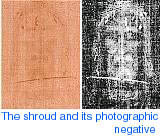 The face of the man of the Shroud is covered with several ecchymoses and swellings. Two most evident marks are a swelling that almost closes his right eye and the abrasion possibly with the fracture of the nasal septum which disfigures the nose. The first could be attributed to a blow, the second to a fall straight on the face, which he could not help because the hands are tied to the wood on his shoulders. The beard bears signs of having being pulled out leaving bare places. This detail of ill use on a person dealt to those accused of blasphemy. We know that Jesus was accused of blasphemy by the high priests. One of the prophecies speaking of the Messiah says: "I have offered my back to those who stuck me, my cheeks to those who plucked my beard; I have not turned my face away from insult and spitting. (Is. 50-6) The face of the man of the Shroud is covered with several ecchymoses and swellings. Two most evident marks are a swelling that almost closes his right eye and the abrasion possibly with the fracture of the nasal septum which disfigures the nose. The first could be attributed to a blow, the second to a fall straight on the face, which he could not help because the hands are tied to the wood on his shoulders. The beard bears signs of having being pulled out leaving bare places. This detail of ill use on a person dealt to those accused of blasphemy. We know that Jesus was accused of blasphemy by the high priests. One of the prophecies speaking of the Messiah says: "I have offered my back to those who stuck me, my cheeks to those who plucked my beard; I have not turned my face away from insult and spitting. (Is. 50-6)
A CAP OF THORNS
Several scientists consider the wounds found on the head of the Man of the Shroud one of the best signs to identify him with Christ.
The deep cuts and hole left in the scalp can only be attributed to thorns. In general painters have represented Jesus with a well woven crown of thorns. Only after the details of the Shroud have become known have some artists represented the head of Christ covered by a disorderly cap of thorns. This kind of torture is practically unique in history. This is described in the Gospel with anatomical and pathological precision.
THREE WOUNDS OF THE CRUCIFIXION
Only three of the wounds of the crucifixion are clearly visible on the Shroud. On the frontal image the pierced left wrist, and on the dorsal image the plant of the two pierced feet. The right wrist is covered by the left hand but on observation one can see the sign of flow of blood. The feet were pressed one on the other and were pierced by a single nail. The weight of the body rested on this one point. The arms out-stretched were nailed by the wrists out-stretched in the form of the cross. The successive movements to ease the pressure on the thorax to make breathing possible, transferring the weight successively from the arms to the feet made all movements extremely painful and breathing spasmodic. The flow of blood in two directions on the wrists and forearms testifies to this double movement.
THE BLOOD TYPE OF THE MAN
The blood on the Shroud is real, human male blood of the type AB (typed by Dr. Baima Ballone in Turin and confirmed in the U.S.). This blood type is rare (3.2% of world population according to Dr. Leoncio Garza-Valdes)-the highest percentage found in northern Palestine. Blood chemist Dr. Alan Adler (Univ. of Western Connecticut) and the late Dr. John Heller (New England Institute of Medicine) found a high concentration of pigment bilirubin consistent with the someone dying under great stress or trauma, and making the colour more red than normal ancient blood. Such finds rule out substances (paint, dye, ink, chalk, etc.) as creating the images. Dr. Victor Tryon and Nancy Tryon of the University of Texas Health, Science Center found X & Y Chromosomes representing male blood & a "degraded DNA" (approx. 700 base pairs) "consistent with the supposition of ancient blood." (Dr. Victor Tryon)
THE SHROUDS FEATURES
The Shroud is a linen cloth woven in a 3-over-l herringbone and measures 14'3" x 3'7". These dimensions correlate with ancient measurements of 2 cubits x 8 cubits - consistent with loom technology of period. The finer weave of 3-over-1 herringbone is consistent with the New Testament. statement that the "sindon" (or shroud) was purchased by Joseph of Arimathea - who was a wealthy man. Also, Leviticus 19:19 speaks of the mixing of linen and cotton, but prohibits linen and wool or the mixing of vegetable and animal. In 1969, Dr. Gilbert Raes of the Ghent Institute of Textile Technology in Belgium noted that there are traces of cotton (identified as Gossipium herbaceum) in the linen of the Shroud.
The image suggested that a man's body was laid upon one end, and the other end folded over the head to cover the front. The weave of the shroud is a herringbone twill pattern common to the region of Palestine at that time. The presence of stray cotton fibres in the linen shows that it was woven on a loom also used to weave cotton fabric. This would rule out Europe, and suggest the Middle East where both linen and cotton were common.
PRESENCE OF POLLEN GRAINS AND FLORAL IMAGES
Pollen samples lifted with plants unique to the arid regions abutting the Dead Sea. "Inflorescence of the crown chrysanthemum (Chrysanthemum coronarium)"; the Rock Rose (Cistus creticus) lateral to the left cheek of the figure on the Shroud; a bouquet of bean caper plants (Zygophyllum dumosum) and a thorn tumbleweed (Gundelia tournefortii) which comprises most of the Crown of Thorns. The shroud at some time, was definitely physically present in the region of Palestine. Evidence also suggest that the flowers on the Shroud were picked in the Spring. The flowers could have been picked up fresh in the fields. A few of the species could be found in the markets of Jerusalem in the Spring of the year, a period consistent with the time of the Passover and the Crucifixion.
THE IMAGE FORMATION
No one knows for sure how the images were created. The images are scorch-like, yet not created by heat and are a purely surface phenomenon limited to the crowns of the top fibers. The Shroud is clearly not a painting. There are no signs of penetration; the blood was on the Cloth before the image (an unlikely way for an artist to work); there is no outline (which world-renowned artist Isabel Piczek calls the horizon event of art); there are no brush strokes, no style of any period or directionality; no binders to hold paint; no evidence of paint, dye, ink, chalk creating the images. The Images shows a perfect photo-negativity and 3 Dimensionality. When the first photograph was taken in 1902 by Italian photographer Segundo Pia - in those days, a sensitised glass plate - developed in the chemical bath, the startlingly human figure in amazing detail emerged. The shroud image commonly published is the positive image. The photographic negative of the original negative image is positive. It is not a Vaporgraph or natural result of vapours. Current theories suggest a possible scorch caused light from a miliburst of radiation consistent with the timing of at the Resurrection resulting in a rapid dehydration; oxidation/degradation of linen colouring it a sepia or straw yellow.

ANCIENT COINS OF PONTIUS PILATE?
Using computerised image-intensity analysis technology developed for NASA's space probes, 3-D imagery of NASA's VP-8 Image Analyzer (Dr. John Jackson, Dr. Eric Jumper and Rev. Kenneth Stevenson in 1978) shows "dense, button-like objects over the eyes" about the size of a U.S. dime. Macrophotography (by the late Fr. Francis Filas, S.J. of Loyola U. in Chicago), and digitalization of the eye area (Dr. Robert Haralick -U. of Virginia Spatial Data Analysis Lab) suggest coin-lettering consistent with the Lepton (Widow's Mite) minted by Pontius Pilate between 29-32 A.D. This was a custom at the time in Palestine, evidently to keep the lids closed.
CARBON-14 TEST OF 1988 REFUTED
Very recent information refutes the accuracy of the 1988 Carbon-14 tests done at Oxford, Zurich and Arizona Labs. Among this information:
- Consistent problems with the dating of linens (Egyptian Bull Mummy; Mummy 1770 Manchester Museum; Ibis Bird Mummy) call the accuracy of linen testing into question.
- The Fire-Model Tests of Dr. Dmitri Kouznetsov in 1994 and Dr. John Jackson and Propp in 1998, which replicated the famous Fire of 1532, demonstrate that the fire added carbon isotopes to the linen.
- Dr. Leoncio Garza-Valdes (microbiologist) discovered a bioplastic coating of bacteria and fungus on the linen fibers (60% by weight) caused by microbes that are living and that absorb and add C-14 to the Cloth and thereby skew the date by at least 1300 years. These microbes were not known at the time of the test and were not removed by the C-14 cleaning protocol.
- Several Physicists such as Dr. John Jackson of the Colorado Shroud Center point to a form of possible columated radiation as best explanation of the phenomenon of the image-formation, representing a scorch-like appearance (scorch caused by light versus heat as the image does not fluoresce). Dr. Thomas Phillips (nuclear physicist at Duke University and formerly with the High Energy Labs at Harvard) points to a potential miliburst of radiation (a neutron flux) - which could be consistent with the moment of Resurrection. (The phenomenon of the image on the shroud has been likened to images found on buildings in Hiroshima and Nagasaki which still stood after the atomic bombs were dropped. Images of certain objects - like a water valve, for example - were projected onto surfaces by the flash of radiating energy that accompanied the blast.) Such a miliburst may be a possible cause of the purely surface phenomenon of the scorch-like (scorch-by-light) images and a possible key to the addition of carbon-14 to the Cloth. As Dr. Phillips points out: "We never had a Resurrection to study" and more testing can be done to ascertain whether a neutron-flux occurred. S.T.U.R.P (1978 Shroud of Turin Research Project involving approx. 35 scientists directly examining the Shroud for five days) determined that the image was caused by a rapid dehydration, oxidation and degradation of the linen by an unidentified process.
IS THE SHROUD A PAINTING?
If it is, the "medieval faker" must have been a man of many parts, a genius. He should have known quite a few things absolutely unknown to science at that time.
He should have known what a "negative" picture is, centuries before photography was invented, in order to reproduce one; so that centuries later, rendered in the positive after the invention of photography, it would offer a clearly recognizable image. Now this notion became available only with the discovery of the photography gradually during the last century. He would have to have an excellent knowledge of anatomy, physiology and hematology. He would have to be an expert in the law, criminal procedure, customs, textile technology and botany of the land of Palestine in the time of Jesus. He would have to be fully conversant with the passion narratives in the gospels, and apply them to the various disciplines listed above. He would have to achieve this without using brush or any color or pigment.
That man should have known centuries before scientists discovered them a number of anatomical and pathological details:
- that a violent scourging on the thorax could provoke emetic fluid to fill the pleuric cavity.
- that this fluid splits into blood cells, which are heavier and sink at the bottom and serum which is lighter and floats;
- that a hole pierced through the space between the fifth and sixth rib can empty this cavity;
- that the abdomen of a person dead of asphyxia swells;
- that the weight of a body can only be held on a cross if the arms are fixed to the wood by nails driven through the 'Destot point';
- that the nail in this case severs or damages the median nerve, forcing the thumbs to close in on the palm of the hand.
This painter - supposing he existed - had to be a very brave man indeed, to dare representing the body of Jesus completely naked, nailed through the wrists, with a cap of thorns on the head, covered with about 120 marks of the scourging and with his hair braided and knotted on the nape. All things against the 'sane' tradition of sacred art of the time. He should also have had at hand a Roman lance and 'flagrum' to be able to reproduce the wounds left by them so perfectly.
PROFESSOR DELAGE'S REACTION
Facing the image of the Man of the Shroud, so disturbing and haunting, and looking at that face at once serene and tormented, Delage, who knows the story of the Gospels, concludes that it is the figure of the historical Jesus.
Yves Delage was a zoologist born at Avignon in 1854. He died at Sceaux in 1920. He taught anatomy at the Sorbone. He was a director of the Zoological Station of Roskoff, founder and director of the Periodical Annee Biologique.
To sustain this conclusion he gambles his own scientific reputation. He answers those who have denied him the right to publish his findings in the Official Acts of the Academy of Science of France. His letter addressed to a friend of his, Charles Richet, Director of the Revue Scientifique who published it in 1902 from page 683 onwards. Delage declares that his conclusions represent a bundle of serious probabilities. He is aware that several people have given in to religious passions to the point of compromising right reason. He observes that if instead of Jesus it were question of a Sargon, or of Achilles of Homerian fame, or of a Pharaoh, all would have applauded. He insists: "I have been faithful to genuine scientific spirit and dealt with this topic with truth alone in view, without any thought of whether, by so doing, I would have served this or the other religious current. For me Christ is a historical figure and I fail to see how some are scandalized at the existence of a document that can prove it.
The case of Delage, which stirred an upheaval in the scientific field in his time, is not important only because it is an historical fact: A professor of the Sorbone who breaks with all his colleagues to defend a theory unacceptable to them and continues to sustain his scientific conclusions in favor of the Shroud, while continuing to be an agnostic. This carries a message relevant in our present time too.
It testifies in favor of the absolute honesty of this man of science. For him science is a test point and a bridge towards others.
At a test point, the findings in his studies lead him to accept a reality (the Shroud in this case) that claims further disturbing demands at every few steps. "This image," he says, "is one of stark realism, impeccable, not a single flaw..."
Delage continued to be an agnostic till the end. Yet he always kept that Figure in a place of honour in his house.
| 